


It can be difficult to identify what is influencing Donald Trump a month into the US and Israel's programme of strikes on Iran.
But it is clear he has a keen focus on the global crude markets.
A statement – or online message – from the American leader about his intentions once would trigger significant swings in prices, as traders seized upon signals the conflict could escalate or de-escalate.
However, in the last week, investors appear to be becoming increasingly wary about the impact of his remarks.
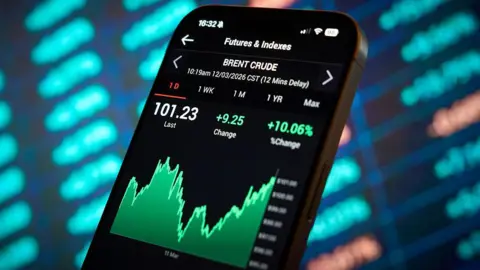
Crude oil was trading at around $72 a barrel (bbl) before 28 February, when the military action against Iran commenced.
Recently, it reached a high of $118 a barrel on 19 March and as of Friday afternoon was valued at around $112 – significantly higher than its pre-war price.
Here are key instances from the past month where Trump and the markets appear to have influenced each other – with varying results.
Use the navigation button to move to the following chart.
"Oil prices have acted as a barometer for wider political and financial uncertainties, spiking when Trump's language becomes aggressive and declining when his language softens," observes one financial expert.
He adds that markets are understandably reactive to those cues, considering the substantial economic risks that are associated with climbing oil prices.
"Market participants are trying to assess genuine risk," he comments. "The markets can seem skittish or bewildered, but what they're really doing is managing event risk in real time, with oil sitting right at the core of that."
However, it can be difficult for investors to figure out how to position themselves, particularly because a portion of Trump's statements appear intended to affecting oil prices, rather than articulating policy, notes another investment advisor.
"As they say, the initial victim of war is truth," he observes. "My belief is some of the communication back-and-forth around productive talks, and the contrary, very much are focused on merely influencing the price of oil."
Investor Response Grow More Muted
On Thursday, moments after US stock markets recorded their sharpest fall since the outset of the conflict with Iran, Trump said discussions with Iran were going "very well" and he was postponing planned attacks on Iran's energy infrastructure until at least 6 April.
Yet, the price of crude continued to increase.
One market analyst points out that investor responses are "becoming more muted" because of the "wide divergence" between Trump's optimistic statements and the absence of acknowledgement from Tehran.
"Given the appearances, a large number of investors do not foresee an quick end to the conflict and financial markets continue to be nervous."
Another investment director says markets have also grown used to Trump "repeatedly changing tack at signs of political, stock market or economic trouble".
"We are seeing a level of wariness, or even downright distrust, creeping in at the edges," he says.


